
Felix Gonzalez-Torres returns to Madrid through an exhibition that connects personal memory, queer history and the fragile politics of participation.
The Felix Gonzalez-Torres Madrid exhibition at the Museo Reina Sofía places one of the most influential artistic practices of the late twentieth century in direct dialogue with a city marked by personal history. Dulce venganza (Sweet Revenge), on view from May 27 to October 12, 2026, is the first large-scale presentation in Madrid of the Cuban-born American artist’s work.
Presented in the Sabatini Building, the exhibition approaches Gonzalez-Torres not only through the formal clarity of his installations, but also through the emotional and political forces that continue to make his work urgently contemporary. For art travelers visiting Madrid, the show offers a rare opportunity to encounter a body of work in which beauty, disappearance, love and public participation remain inseparable.
Madrid as a charged point of return
Madrid was not a neutral place in the life of Felix Gonzalez-Torres. In 1971, he was sent to Spain as part of a program designed to move children out of Cuba. He stayed for only a short time before moving to Puerto Rico and later to New York, where he would spend most of his adult life.
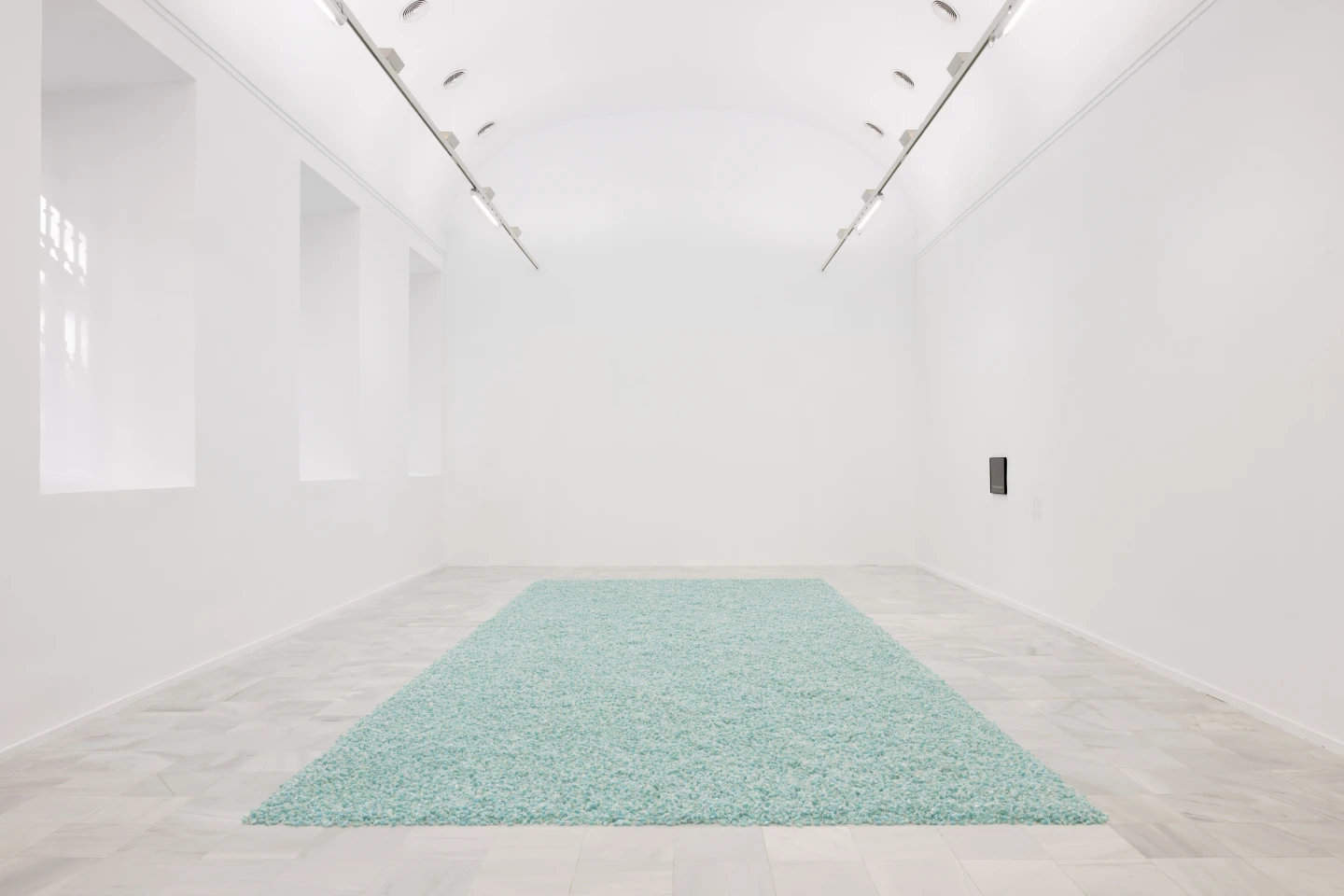
That early displacement gives the exhibition its emotional density. Gonzalez-Torres did not return to Madrid until 1991, when he participated in a group exhibition and presented “Untitled” (Revenge), a sculpture made from crystalline blue candies. Reflecting on that return after almost two decades, he wrote: “I have returned to Madrid after almost twenty years: sweet revenge.”
The phrase becomes more than a title. In this exhibition, “sweet revenge” operates as a method for approaching a practice built around paradox: intimacy and politics, presence and absence, permanence and change.
Contradiction as artistic structure
Gonzalez-Torres’s work often appears visually restrained, but its apparent simplicity holds multiple emotional and political layers. The parenthetical elements in his titles frequently open the works toward references that are not immediately visible: romance, illness, war, private memory and social conflict.
This tension is central to Dulce venganza. The exhibition shows how Gonzalez-Torres used contradiction not as a secondary effect, but as a structural principle. His works can be tender and severe, public and intimate, minimal and deeply charged. Their power often lies in the distance between what is physically present and what is only suggested.
That ambiguity gives the work its lasting force. Rather than imposing a single meaning, Gonzalez-Torres created conditions in which viewers become implicated. The artwork is not fixed as an object to be contemplated from a distance; it changes through contact, removal, replenishment and memory.
Candy, paper and the role of the viewer
The exhibition includes key formats associated with Gonzalez-Torres’s practice: stacks of paper, piles of candies, curtains, billboards and strings of lights. These works are governed by protocols that allow them to be replenished indefinitely as the public takes elements away.
This gesture radically alters the relationship between artwork and viewer. Participation is not decorative; it becomes part of the work’s existence. Each visitor who takes a sheet of paper or a piece of candy contributes to a process of disappearance and renewal, making the artwork both vulnerable and continuous.
In this sense, Gonzalez-Torres’s installations resist the idea of the artwork as a stable, closed form. They leave space for contingency, transformation and reinterpretation. Their fragility is not a weakness, but a condition of meaning.
Love, grief and political urgency
As a queer artist working during the most devastating years of the AIDS crisis, and within a United States shaped by conservative politics, Gonzalez-Torres developed a language that was deliberately unstable, participatory and personal. His work is deeply marked by the death of his partner from AIDS in 1991, yet it never separates mourning from love.
That elegiac dimension remains central to the exhibition. Gonzalez-Torres transformed grief into forms that could circulate publicly without losing their intimacy. His works do not illustrate loss; they allow it to be experienced through matter, repetition and shared gesture.
Dulce venganza ultimately presents Felix Gonzalez-Torres as an artist whose work continues to challenge how museums, viewers and cities engage with memory. At Museo Reina Sofía, the exhibition shows how aesthetic forms can carry emotional resonance and political urgency without becoming didactic.
Read more international art stories in the Lemon Art Magazine News section.